The Rise of the Software Factory — Orchestrating Autonomous Development
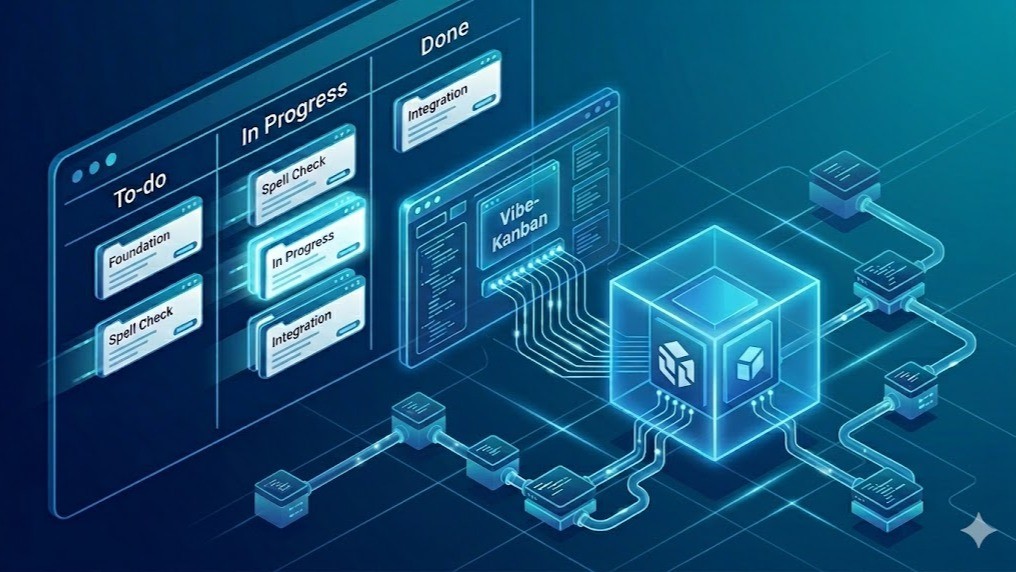
The landscape of software engineering is shifting from manual coding to a "software factory" model, where autonomous and semi-autonomous agents handle the heavy lifting of the development life cycle. This transformation isn't just about AI writing code snippets; it is about AI orchestration — managing tasks from initial design to testing, verification, and repository management.
Orchestration: The New Role for Developers
At the heart of this evolution is Vibe-Kanban, an AI orchestration tool that integrates directly with source control repositories. Instead of writing every line of code, developers now act as architects and orchestrators. By creating a task board with traditional "To-do, In Progress, Review, and Done" swimlanes, you can instruct AI agents like Qwen AI to work on specific work items autonomously.
The power of this model lies in parallel execution. In a recent demonstration, a complex project was broken down into nine discrete tasks that were executed simultaneously, completing in roughly 10 minutes — a feat that would typically take a human developer significantly longer.
Back to the Future: The Modular Unix Approach
Interestingly, the key to successful autonomous development may lie in the past. The Kernighan Bell Labs approach from the early days of Unix — which focuses on small, isolated programs that pipe outputs to one another — is uniquely suited for AI agents.
By building modular tools (such as a spell-checker composed of simple Unix commands like sed, grep, and awk), we can:
- Minimize merge conflicts — isolated tasks operate on different parts of the code base simultaneously without interference.
- Facilitate testing — each "mini-program" can be tested and verified individually before integration.
- Simplify AI prompts — smaller, segmented work items are much easier for an AI agent to process than large, monolithic frameworks.
Safety First: Managing "YOLO Mode"
To maximize efficiency, AI agents often need to operate in what is called "YOLO mode," utilizing the "dangerously skip permissions" flag to iterate rapidly without constant manual approval. While this speeds up development, it introduces risks like prompt injection attacks, where an agent might gain unintended trust on a local system.
The solution? Isolation. Using Docker Dev Containers creates a sandboxed environment where the AI agent only has access to a specific volume mount. This allows the "software factory" to run at full speed while keeping the rest of your system secure.
Autonomous Debugging and the Iterative Loop
Autonomous development is rarely a "one-shot" success. The true value of an orchestration tool like Vibe-Kanban is its ability to handle autonomous debugging. When the generated software encounters an error, the developer simply pastes the error output back into a new "to-do" item. The AI agent then:
- Reads the error log.
- Identifies path issues or script errors.
- Fixes the code and updates relevant tests.
- Submits a new Pull Request for review.
Conclusion
We are entering an era where modular design, bash scripting, and simple patterns are more relevant than ever because they facilitate AI-driven automation. Tools like Vibe-Kanban and Qwen AI are proving that with the right orchestration and a secure sandbox, the "software factory" is no longer a concept — it's a reality.
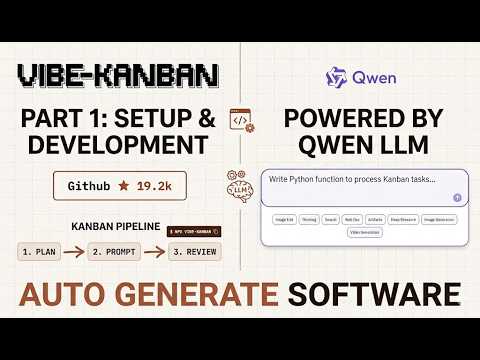
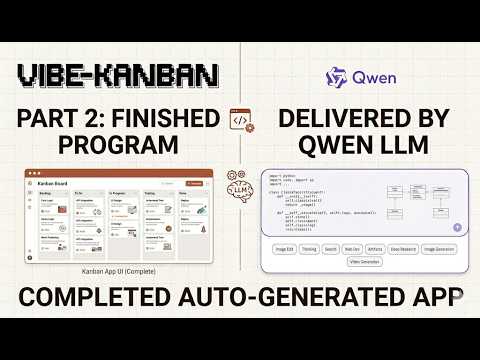
To see these concepts in action, check out the full video demonstration on auto-generating software using Vibe-Kanban and Qwen, in two parts: